September 2025 - present
Tethered
Unreal Engine 5 action rogue-lite prototype focused on modular combat, encounter, travel, and persistence systems.
- Role
- Lead System Designer and Gameplay Engineer
- Status
- In development
- Engine
- Unreal Engine 5.8
Overview
Tethered is a single-player isometric action rogue-lite with fast-paced melee combat, built on Unreal Engine 5 and the Lyra framework. I lead the system design and gameplay architecture, with a focus on modular combat, encounter flow, room-to-room travel, and persistent run state.
It is a functional prototype built to demonstrate how core gameplay systems sit on a modular, data-driven architecture that can expand into a full game. The thesis behind the project: a small team can use Lyra-aligned structure to keep systems decoupled and add content by authoring data rather than writing new systems code. Developed in collaboration with a student team at CSU Fullerton, the project serves as a technical demonstration of Lyra-aligned systems in a high-iteration environment.
Team
I lead system design and gameplay architecture (combat, encounter, travel, persistence). The wider team covers sound (Daniel DiPietrantonio), AI (Kathy Nguyen), and physics (Sinan Abdul-Hafiz), with Lidia Morrison as project advisor.
Core Gameplay Loop
Hub world, loadout selection, run initiation, seamless travel into arena rooms, wave-based encounters, room-clear gating, upgrade acquisition, and return. World state carries across rooms and across runs.
Architecture
Tethered uses three Ability System Component (ASC) owners for different layers of gameplay state:
- PlayerState hosts player abilities, attributes, and equipment.
- Enemy Character hosts per-enemy abilities and health.
- Lyra GameState hosts world-level state, event broadcasting, encounter orchestration, and spawn modifiers.
All systems gate on Lyra experience initialization before touching any ASC, which prevents null-reference failures during level load.
World ASC as a shared event bus
The world-level ASC broadcasts and coordinates system-level events and state changes, keeping room triggers, encounter orchestrators, and spawn modifiers decoupled while still communicating at runtime. A dedicated attribute set holds run-level scalars: difficulty multiplier, curse and blessing stacks, threat level, and floor number. World state is reconstructed after every room transition so enemies scale and gain behaviors from active modifiers without changes to their base definitions.
Game Feature Plugin isolation
Game-specific code lives primarily in a single Game Feature Plugin that extends Lyra through GameFeatureAction injection points and subclasses core engine and Lyra classes. This keeps project code separate from Lyra base systems so new features do not modify existing ones.
Seamless travel subsystem
A GameInstance-owned travel subsystem owns level transitions and implements the engine’s loading-process interface, so the engine polls it each frame to decide whether to show a loading screen. It snapshots run state before travel, triggers server travel, waits for the destination experience to load, then reconstructs player and world state before clearing the loading screen. A per-world bridge helper hooks the new world’s Lyra experience-loaded event back into the persistent travel subsystem.
Persistence and pluggable save backend
A GameInstance save-manager subsystem holds active run state in memory and delegates disk I/O to a pluggable save-backend interface. The backend can be swapped, for example for a future server-backed implementation, without changes to any other system. Persistence acts as a single source of truth between the live ASC and the save file, using Unreal’s native SaveGame system for unlocked weapons, character stats, and permanent upgrades, saving at checkpoints such as room completion and hub return, with validation to handle missing or malformed data gracefully.
Encounter orchestration
Encounters are driven by an encounter Gameplay Ability on the world ASC. Trigger volumes send encounter definitions to the GameState as gameplay events, which the encounter ability reads to begin spawning waves. Wave-advance conditions are modular rule abilities composed per wave without modifying the encounter ability, so new encounter types are authored entirely through data.
Spawn modifiers
A persistent spawn-modifier ability listens for spawn events and evaluates modifier rules against current world state, applying matching Gameplay Effects to spawned actor ASCs at spawn time. New modifier types are data entries, not code changes.
Room completion via listener interface
On encounter initiation, the trigger volume passes a list of room-completion listener references to the encounter ability as initiation data. On completion, the ability notifies each registered listener directly. Doors, exit portals, and loot spawners respond to room clear with no coupling to the encounter system beyond the interface contract. New behaviors are added by implementing the interface and registering at the trigger volume.
Designer-facing combo and attack routing
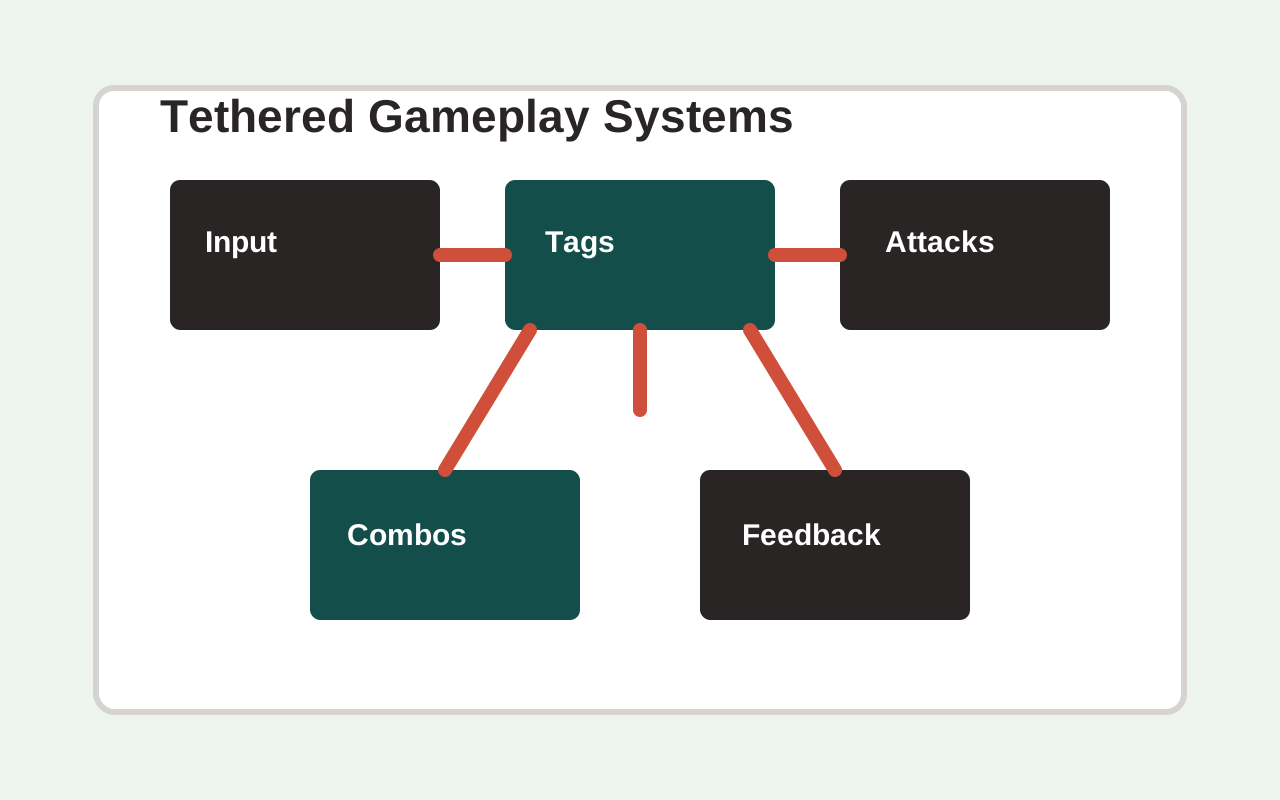
An input-tag routing map drives combat: each combo step evaluates owned Gameplay Tags at runtime to resolve AI and player-executed attacks, so upgrades modify movesets without branching logic. The combo system expands during runtime through upgrades.
AI
Enemies are Behavior Tree driven, with reusable behavior subtrees for shared actions (chase, select attack, reposition) so enemy profiles compose from shared logic without monolithic per-enemy code. EQS handles basic tactical decisions, and perception range triggers the transition from idle into combat.
Chaos destruction
Environmental walls and pillars are converted into Geometry Collections that simulate physics and respond to designer-defined events, with per-object mass and break thresholds, integrated with VFX for readable destruction feedback.
Engine migration (5.6 to 5.8)
I carried the GAS-based Lyra project up two major engine versions, 5.6 to 5.7 to 5.8, resolving API deprecations, build and registration breakage, and Lyra base-class changes at each hop. The project builds and opens cleanly on 5.8.
Server-authoritative design
Gameplay is built using server-authoritative GAS flows rather than client-local shortcuts. This design choice keeps authority boundaries explicit and better positions the architecture for future cooperative multiplayer work without requiring a core systems rewrite.
Testing and Integration
I test through manual in-editor passes, PIE smoke tests, and cross-travel integration checks. A GameInstance-based test-relay pattern writes expectations before travel and asserts after the destination experience loads. Per-system tests cover travel round trips, persistence reconstruction, weapon and ability survival across travel, run-reset of mid-run upgrades, encounter activation and wave advance, double-encounter blocking, spawn-modifier application gating on world tags, and full save-to-disk and relaunch restoration.
Narrative and World
A Control-inspired brutalist megacorp tower, mechs versus aliens, with themes of identity and consciousness - a project with deep investment in both narrative and technical systems.
Key Takeaways
Through developing Tethered, the primary focus has been navigating architectural tradeoffs:
- Decoupled State Management: Establishing clear ownership between local player state, transient world state, and persistent save data.
- Workflow Efficiency: Creating extensible data-driven frameworks (encounters, combos, spawn rules) so that new content can be added and balanced without compiler overhead.
- Robust Lifecycles: Handling complex Unreal Engine lifecycles, particularly managing state reconstruction during seamless travel transitions.